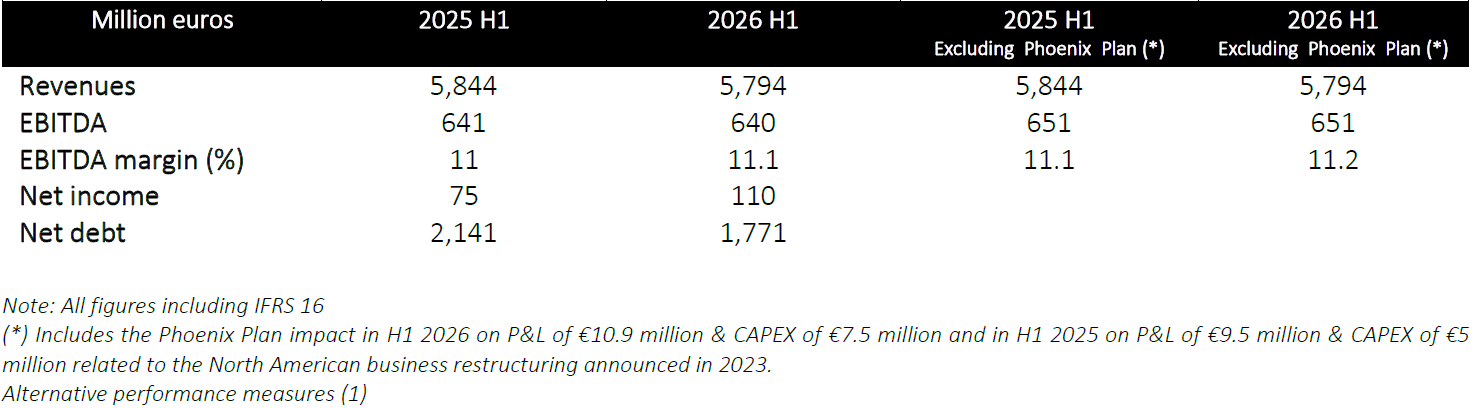
Gestamp, the multinational specialized in the design, development and manufacture of highly engineered metal components for the automotive industry, reported revenues of €5.7 billion for the first half of 2026. This amount represents a slight year-on-year decrease of 0.9%, mainly reflecting the impact of adverse foreign exchange rates in certain markets where the company operates.
Gestamp continued to operate in a market environment influenced by global light vehicle production trends, which declined by 0.9% year-on-year in the first half of 2026, according to S&P Global Mobility.
During this period, the company continued to implement efficiency initiatives, cost-control measures and profitability improvement actions, enabling Gestamp to maintain EBITDA at €651 million (excluding the impact of the ‘Phoenix Plan’), in line with the same period of the previous year. EBITDA margin improved by 10 basis points year-on-year, reaching 11.2% at the end of June.
The company's progress in improving profitability continues to be particularly significant in North America, where it operates in both the United States and Mexico and is executing the ‘Phoenix Plan’ to bring the region's margins closer to those achieved in its other markets. Specifically, Gestamp closed the first half of the year with an EBITDA margin of 8.0% in North America, compared to 7.1% a year earlier. During the second quarter alone, the margin increased to 8.8%, allowing the company to reaffirm its objective of reaching double-digit profitability by year-end. Operational efficiency initiatives continue to play a key role in expanding margins in North America, where light vehicle production remained broadly flat during the first half of the year, according to S&P Global Mobility.
Gestamp's net income performance was mainly influenced by positive non-recurring items, including lower foreign exchange rate differences than in the previous year and one-off impacts related to financial expenses. These extraordinary factors explain the 47% year-on-year increase in net income, which reached €110 million between January and June, returning to first-half levels recorded before the atypical performance seen in 2025.
Francisco J. Riberas, Executive Chairman of Gestamp, said: "
The company remains focused on its strategy of enhancing efficiency and operational flexibility in mature markets while selectively expanding industrial capacity in the high-growth regions where we operate to capture their development potential. At the same time, we continue to strengthen our financial position, enabling us to maintain our leadership and competitiveness in a challenging environment where visibility remains limited”.
"
The results for the first half are in line with Gestamp's guidance and demonstrate that our ability to anticipate market developments and adapt accordingly continues to enable us to generate sustainable value for our stakeholders," he added.
Net debt reaches its lowest first-half level since 2017
Gestamp's net debt stood at €1.7 billion at the end of June, down 17% from the €2.1 billion reported a year earlier. Meanwhile, the company's leverage ratio remained in line with its targets, declining to 1.4x EBITDA.
The strategy implemented over recent years has enabled the company to consolidate a strong financial profile while progressively reducing its indebtedness. As a result, both the nominal volume of net debt and the leverage ratio reached their lowest first-half levels since 2017, the year Gestamp became a publicly listed company.
Gestamp also continued to strengthen its cash generation capacity, reporting free cash flow of €86 million (excluding the impact of the ‘Phoenix Plan’) during the first six months of the year, compared to €99 million a year earlier.
 Progress towards delivering 2026 guidance
Volatility continues to shape global light vehicle production, which is expected to decline to 91.1 million units by year-end, representing a 2.1% decrease compared with the previous year, according to S&P Global Mobility estimates. The automotive data and intelligence provider has revised its forecasts downwards several times, and its current outlook is 1.7 million units lower than projected in February, mainly due to downward revisions in China, although other markets are beginning to show signs of stabilization.
Gestamp's performance during the first six months of the year allows the company to reiterate its full-year guidance, which targets an EBITDA margin above 11.7% and an operating cash flow conversion ratio in the 35% range.
Throughout the remainder of the year, the company will continue implementing initiatives aimed at improving efficiency, operational flexibility and profitability, while maintaining a highly selective investment strategy focused on countries where it has operations and which offer strong growth prospects.